Official websites use .gov
A .gov website belongs to an official government
organization in the United States.
Secure .gov websites use HTTPS
A lock (🔒) or https:// means you've safely connected to the .gov website. Share sensitive information only on official, secure websites.
The BETA Center Makerspace offers the NIH research community access to various fabrication tools and equipment to help meet their needs. Through project consultation, workshops, and hands-on training, the Makerspace aims to help users build their confidence in operating available fabrication equipment to innovate and advance their research.
For more information about how to access and use the equipment please visit the Makerspace at Building 13 Room 3W31 or email us at BETACenterMakerspace@mail.nih.gov.
Fused Disposition Modeling (FDM), also known as Fused Filament Fabrication (FFF), is a versatile 3D printing method that can be used from the prototyping phase up through final production, depending on the user’s needs. FDM 3D printers extrude a thermoplastic filament through a heated nozzle, depositing the material layer by layer to create a three-dimensional object. The Makerspace’s FDM 3D printers are capable of small- to large-scale prints using hard and rigid plastic materials.
Model
Build volume
Z-layer height resolution
Materials
Bambu X1E FDM
256 mm x 256 mm x 256 mm (10 in x 10 in x 10 in)
0.08 mm, 0.16 mm, 0.2 mm, and 0.28 mm
Polylactic acid (PLA), polyethylene terephthalate glycol (PETG), polyvinyl alcohol (PVA, for support print only)
Modix BIG-120Z FDM
600mm x 600mm x 1200mm (23.5 in x 23.5 in x 47 in)
0.4 mm and 0.6 mm
Polylactic acid (PLA) and polyethylene terephthalate glycol (PETG)
Resin 3D Printers
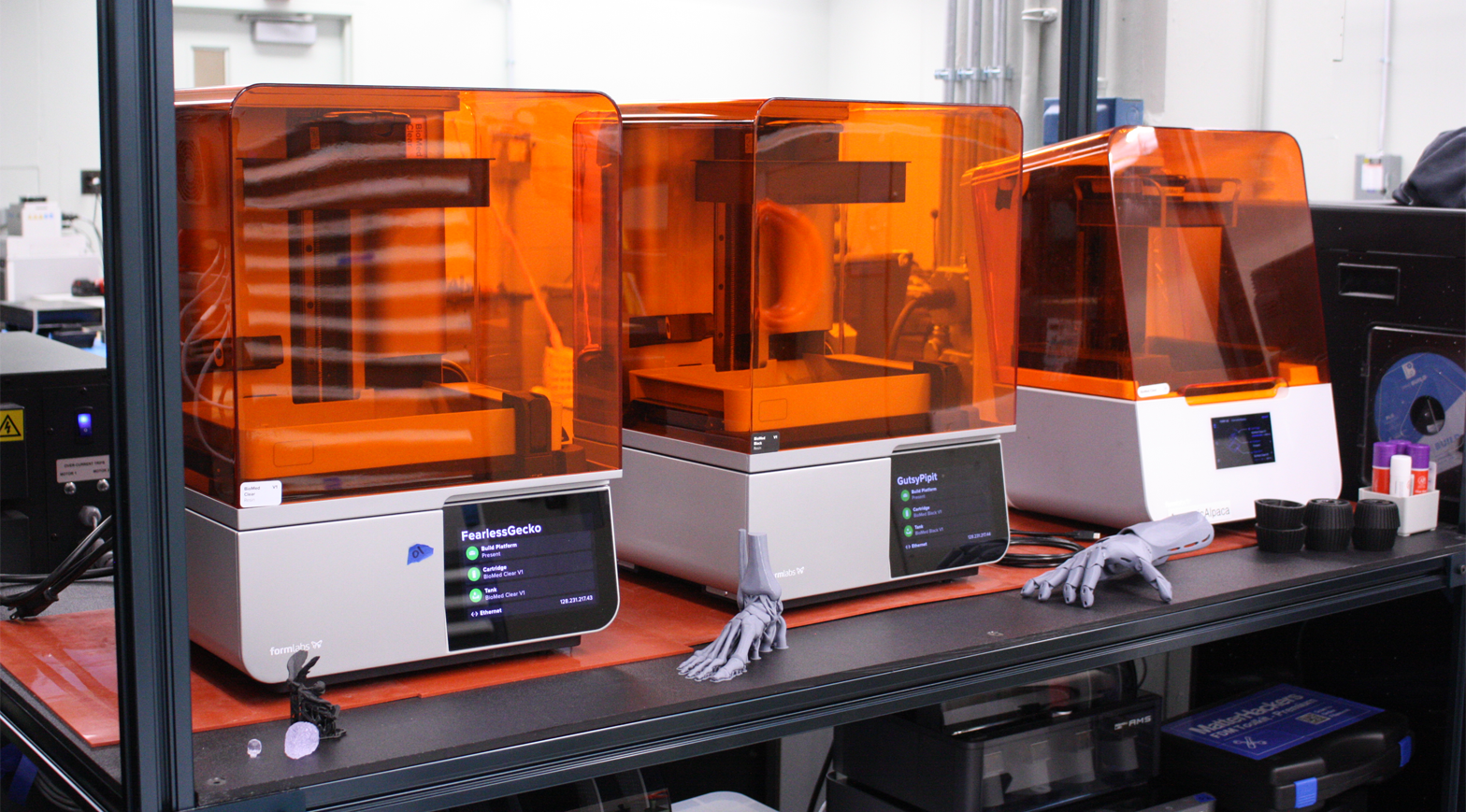
Stereolithography (SLA) or resin 3D printers are capable of printing with high resolution, producing smooth surfaces for prints requiring high precision and fine details. SLA 3D printers use lasers or LED screens to project UV light to cure liquid resin into a solid layer by layer. The Makerspace is suited with resin printers of two different print volumes, capable of printing with various materials, including biocompatible resin.
Model
Build volume
Z-layer height resolution
Materials
Formlabs Form 4B
200 mm x 125 mm x 210 mm (7.9 in x 4.9 in x 8.3 in)
0.025 mm to 0.2 mm (depending on material)
BioMed Clear and BioMed Black
Formlabs Form 3L & 3BL
335 mm x 200 mm x 320 mm (13.2 in x 7.9 in x 12.6 in)
0.025 mm to 0.3 mm (depending on material)
Standard Gray, Standard Clear, BioMed Black, BioMed Clear, and BioMed Flex
Laser Cutter
Media Image
Credit: NIBIB
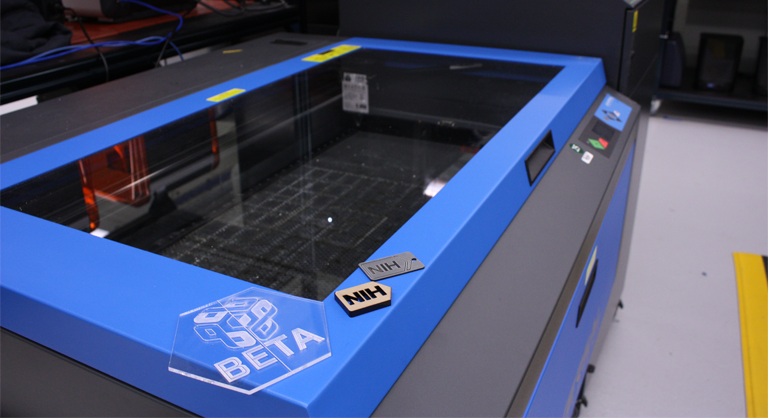
A laser cutter is an engraving and cutting machine that works by directing a high-powered laser onto a material’s surface and causing it to melt, vaporize, or burn away, resulting in a precise cut or engraving. The laser cutter reads vector image files. One of the greatest utilities of a laser cutter is to cut out the sides of boxes or enclosures of custom dimensions. The Makerspace’s specific model is a 150W CO2 laser cutter.
Model
Work area dimensions
Maximum cut thickness
Materials
PLS3.150D Universal Laser Cutter
813 mm x 457 mm (32 in x 18 in)
0.25 in
Acrylic sheets
Metal 3D Printer and Dry Electropolisher
Media Image
Credit: NIBIB
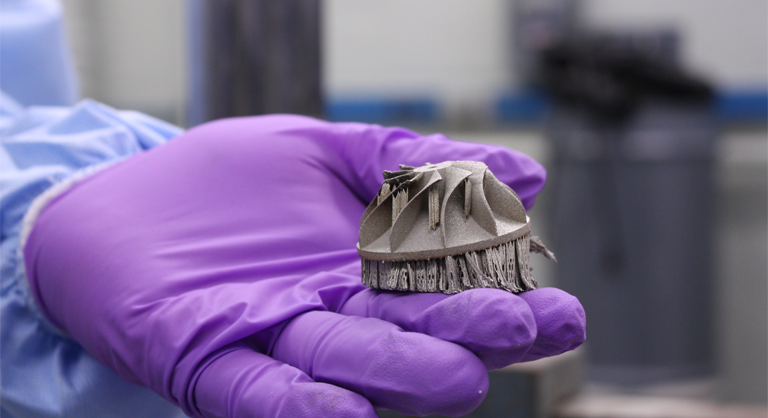
The most advanced 3D printer in the Makerspace is a metal 3D printer. This printer is capable of printing solid stainless steel or cobalt chrome parts in high resolution. Any interest in the metal 3D printer, please reach out to the Makerspace staff for a consultation. As a companion to the metal 3D printer, the Makerspace has a dry electropolisher. Unlike the traditional method of electropolishing, our machine uses a bead-like medium to smooth, deburr, and polish metal parts. The electropolisher can be used to finish metal 3D printed and non-3D printed metal parts.
Model
Print/work volume
Z-layer height resolution
Materials
Xact XM200G metal 3D printer
150 mm x 150 mm x 150 mm (5.9 in x 5.9 in x 5.9 in)
0.02 mm to 0.1 mm
316 Stainless Steel and Cobalt Chrome
Dry electropolisher
180 mm (in diameter) x 80 mm
N/A
Most metals, except aluminum
Other Equipment and Tools
To complement its larger equipment, the BETA Center Makerspace also provides access to a variety of hand and power tools, electronic test equipment, a UV curing system, and more.
 An official website of the United States government